
How to measure tennis racket swing weight at home
You can measure swing weight at home with a table, two knitting needles or pens, a kitchen scale and a tape measure. Hang the racket from its head so it can swing like a pendulum, time the swing, and combine that time with the racket’s weight and balance point. No swing weight machine is needed, and the result is a measurement of your racket, not an estimate from a spec sheet.
Why a swinging racket gives its swing weight
Swing weight, often written swingweight, says how hard a racket is to swing: how heavy it feels in motion rather than on a scale. It depends on how the weight is spread along the frame. Weight near the tip makes a racket harder to swing than the same weight near the handle.
A racket hung from its head is a pendulum, and how long each swing takes depends on exactly that spread of weight. So if you time the swing and know the weight and where it balances, you can work out the swing weight. By convention it is quoted about a point 10 cm from the butt cap, in kg·cm².
What you need
- Two thin, smooth rods to hang the racket on: knitting needles or pens.
- Something heavy to hold the rods down, such as a box of books, and a solid table.
- A kitchen scale that reads to the gram.
- A tape measure.
- A way to time the swing. A stopwatch works with care; a phone camera is easier (see below).
1. Weigh the racket
Weigh it exactly as you play with it: strung, with the grip, overgrip and any dampener on. Write it down in grams.
2. Find the balance point
Rest the racket across a single pen or the edge of a ruler and slide it until it sits level on its own. Measure from the butt cap (the end of the handle) to that point, to the millimetre. Most club rackets balance between 30 and 34 cm.

Take care here. The balance point matters more than any other number: an error of one millimetre moves the result by about two points.
3. Measure the hang point
The racket will hang by its top cross string, the cross string nearest the tip. Measure from the butt cap up to that string, again to the millimetre.
4. Set up the rig
Lay the two rods across the table so they stick out over the edge, evenly spaced either side of the centre of the racket head, and weigh them down well. Hang the racket head-up on the overhanging ends, resting by its top cross string, with the handle dangling free. The rods should touch that cross string only, not the main strings.
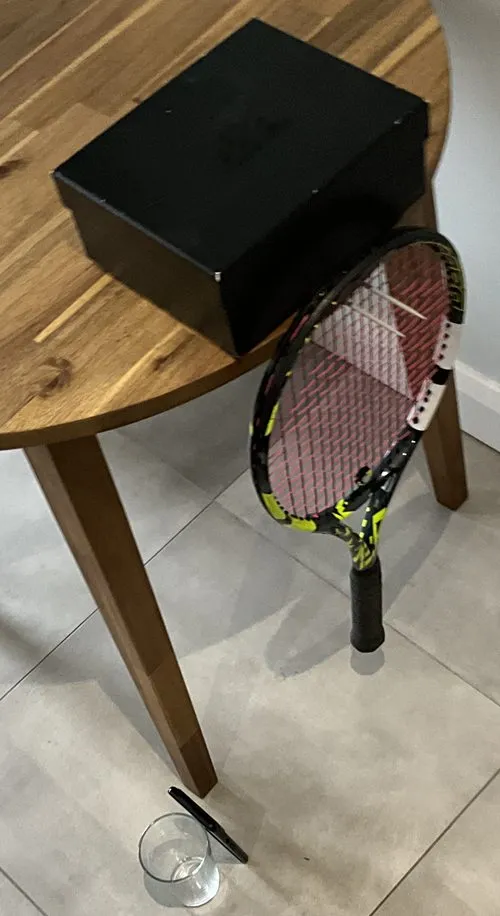
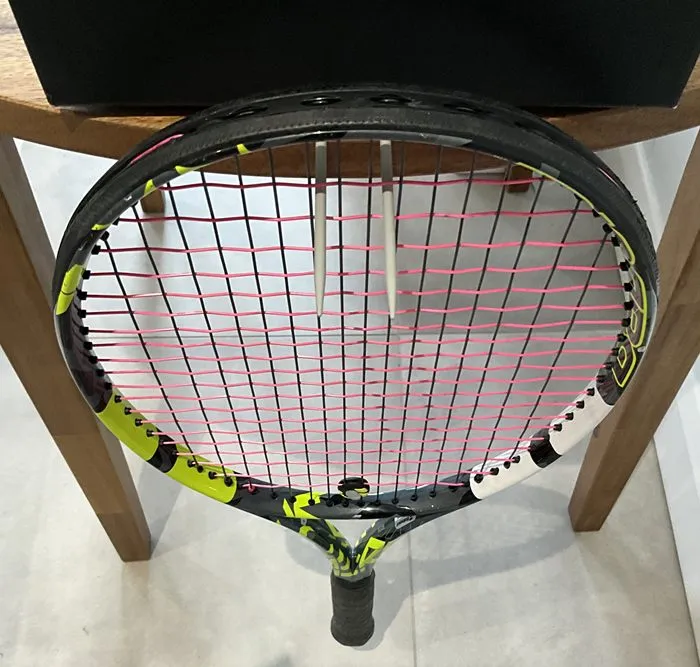
5. Start it swinging
Nudge the handle gently towards the table by 5 to 10 cm and let go. The racket swings out from the table and back. Keep the swing small: a bigger swing takes longer than the sums below assume, and reads high. Let it settle for a couple of swings before timing.
6. Time it
Time how long one full swing takes, out and back, which is called the period. A single swing is far too short to time by hand, so time many in a row and divide. Swing weight is very sensitive to this number, so the more swings you average, the better. If anything touches the racket or the rig while you count, start again from one.
7. Work it out
With the weight m in kilograms, the lengths in metres from the butt cap (balance point b, hang point h), and the period T in seconds:
- The distance from the hang point to the balance point: d = h − b.
- How hard the racket is to turn about the rods: I = m × 9.81 × d × T² ÷ (4 × π²).
- Move that to the racket’s centre of balance: I₀ = I − m × d².
- Move it to the standard point 10 cm from the butt cap: swing weight = I₀ + m × (b − 0.10)².
- Multiply by 10,000 to get kg·cm².
Steps 3 and 4 are the parallel axis theorem, the standard way to move a moment of inertia from one axis to another.
Let the phone do the timing
RacketCheck does steps 6 and 7 for you. Stand the phone to one side, under a metre away, in line with the table edge and level with the handle: on a tripod or propped against a glass, which on most tables means on the floor. Type in the weight, balance point and hang point, start the swing, and the camera watches the handle sweep past.

The camera is a stopwatch, not something that recognises your racket. It ignores the first couple of swings while the swing settles, then times about ten full swings in a row. Every one of them has to agree. A racket left alone keeps a very steady time, so a swing that doesn’t match means something disturbed it: a hand, a knock, a rod that slipped. The swings around a disturbance no longer describe the racket alone, so the count doesn’t skip the odd one out; it starts again from one. The result comes with the spread it was measured to: a tight spread means the rig was steady. Nothing is recorded; the camera only watches the handle move.
If it goes wrong
- The count keeps starting again. A rod slid, the table wobbled, or the racket was touched. Weigh the rods down well, stand the rig on something solid, and step back once it is swinging.
- The camera misses swings. Turn on the light in a dim room, and make sure the handle stands out against what is behind it.
- The answer looks wrong. Check that the racket hangs head-up with the handle down: the hang point should be far up the frame, near the tip. Then measure the balance point again, since it is the most sensitive input.
- The racket barely swings. The rods are too close to the balance point. Hang it from the top cross string as described.